
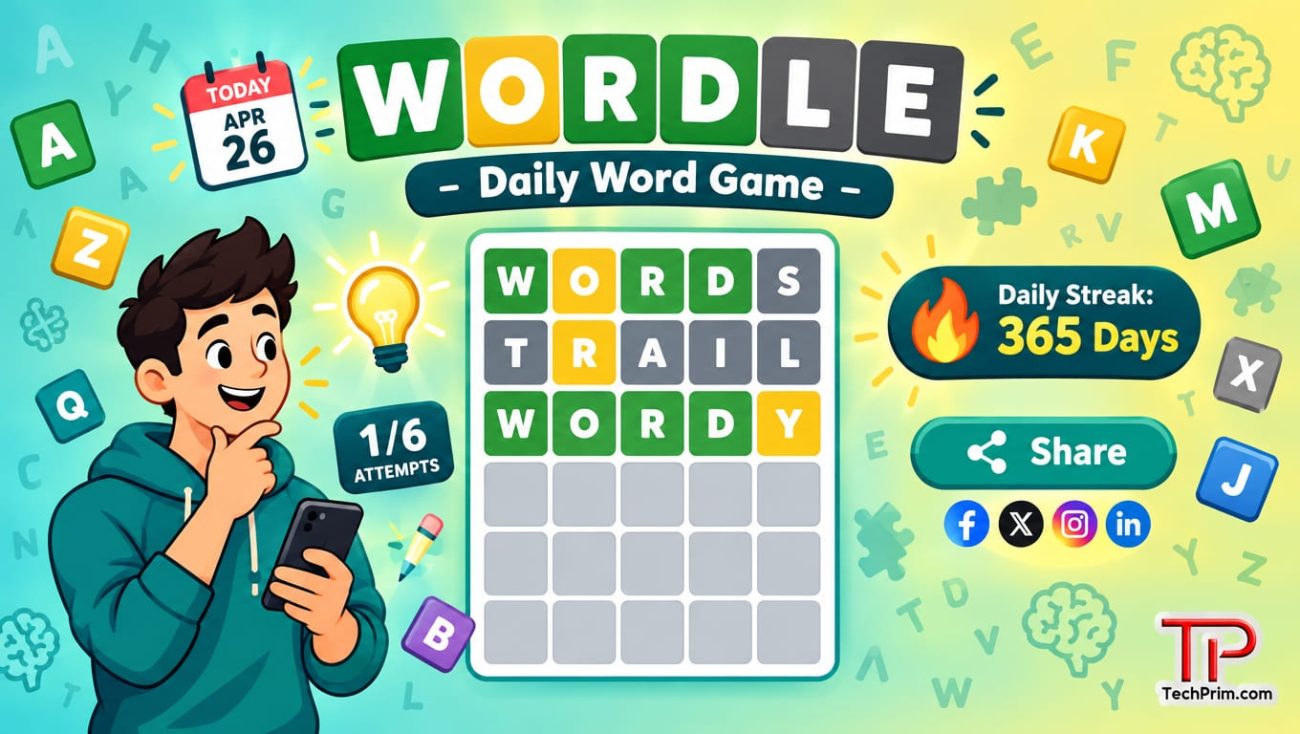
Looking for games like Wordle that are quick, clever, and easy to fit into your day? You have plenty of options beyond the familiar five-letter puzzle. Some Wordle alternatives use similar color-coded clues, while others focus on categories, word associations, geography, anagrams, or crossword-style logic.
Quordle and Waffle are good places to start if you want a game like Wordle with an extra challenge. If you prefer finding relationships between words, PuzzGrid and Red Herring are among the closest Connections alternatives. Contexto, Worldle, and Minute Cryptic offer more distinctive formats without requiring a long gaming session.
Many of these daily puzzle games work in a web browser or on a mobile device. That makes them convenient casual puzzle games for a coffee break, commute, or quiet moment at home.
Some titles provide free daily play, while others include advertisements, paid archives, optional subscriptions, or premium modes. Access can change, so check each game’s official website or app for current details.
Quick Answer: Which Game Should You Play?
- Best overall Wordle alternative: Quordle
- Best visual word puzzle: Waffle
- Best Connections alternative: PuzzGrid
- Best vocabulary game: Blossom
- Best meaning-based word game: Contexto
- Best geography game: Worldle
- Best introduction to cryptic clues: Minute Cryptic
Best Games Like Wordle at a Glance
| Game | Best for | Main challenge | Platform |
|---|---|---|---|
| Quordle | Experienced Wordle players | Solve four words together | Browser |
| Waffle | Visual puzzle fans | Rearrange letters in a grid | Browser and mobile |
| Strands | Theme hunters | Find connected words in a letter grid | Browser and app |
| Spelling Bee | Vocabulary practice | Create words from seven letters | Browser and app |
| Blossom | Score-focused word fans | Build 12 high-scoring words | Browser |
| PuzzGrid | Connections fans | Sort 16 clues into four groups | Browser |
| Red Herring | Mobile puzzle fans | Group words while avoiding decoys | Mobile app |
| Contexto | Lateral thinkers | Find a word using semantic feedback | Browser |
| Semantle | Patient puzzle solvers | Identify a semantically related word | Browser |
| Worldle | Geography learners | Guess a country from its shape | Browser |
| Globle | Map and trivia fans | Find a country using proximity clues | Browser |
| Knotwords | Crossword and logic fans | Complete words using letter groups | App |
| Minute Cryptic | Cryptic crossword beginners | Solve one guided cryptic clue | Browser |
How We Chose These Daily Puzzle Games
For this guide, we reviewed each game’s official instructions, current availability, core puzzle format, learning curve, and similarity to Wordle or Connections.
We prioritized daily puzzle games with:
- Clear and approachable rules
- Useful feedback after each guess
- Browser or mobile access
- Short sessions that fit into a daily routine
- Active official websites or supported apps
- Meaningful word, logic, or geography challenges
We also considered whether each option works for casual players. However, we do not assume that every feature is free. Archives, hints, advanced statistics, premium modes, and ad-free access may require an account or payment.
Wordle Alternatives for Letter and Vocabulary Fans
1. Quordle
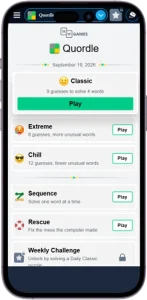
Best for: Wordle players who want a harder challenge
Quordle applies each guess to four separate five-letter boards. You have nine attempts to solve all four answers.
The basic feedback will feel familiar to Wordle players. A correctly placed letter receives one color, a letter in the wrong position receives another, and an unused letter is marked separately.
The challenge comes from managing information across four boards. A guess that nearly completes one answer may reveal little about the other three. Sometimes the better strategy is to test several unused letters rather than immediately finish the easiest word.
Why you may like it:
- It preserves Wordle’s familiar guessing system.
- One guess affects four puzzles.
- It requires more planning than a single board.
- The rules are easy to understand if you already play Wordle.
Among the available other Wordle games, Quordle is one of the closest to the original format.
2. Waffle
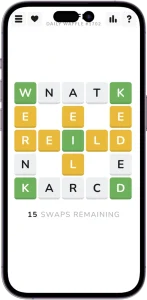
Best for: Players who prefer rearranging letters
Waffle gives you the required letters from the beginning, but many of them are in the wrong positions. You swap the letters until every horizontal and vertical word is correct.
The standard daily puzzle allows up to 15 swaps. Color feedback indicates whether a letter is correctly placed, belongs elsewhere in the same word, or needs to move to another part of the grid.
Waffle is a fun game like Wordle, but it depends less on open-ended guessing. The main challenge is making efficient swaps. One carefully chosen move may improve two intersecting words at the same time.
Why you may like it:
- All the required letters are visible from the start.
- It combines vocabulary with spatial logic.
- The limited number of swaps encourages careful planning.
- Each puzzle has a clear endpoint.
3. Strands
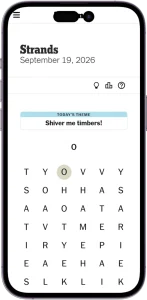
Best for: Players who enjoy themes and word searches
Strands is a daily New York Times word game built around a themed letter grid. You find connected words that relate to the day’s topic.
Each puzzle also contains a spangram. This special answer describes the theme and reaches from one side of the board to another. Finding it can make the remaining words easier to identify.
Strands sits somewhere between a word search and a category puzzle. It is a natural choice if you enjoy Wordle’s daily structure and the thematic reasoning found in Connections.
Why you may like it:
- Every puzzle has a central theme.
- Words can move in several directions.
- Hints are available when you get stuck.
- The spangram creates a satisfying final discovery.
4. Spelling Bee
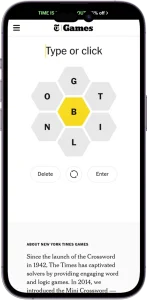
Best for: Building vocabulary at your own pace
Spelling Bee presents seven letters around a required center letter. You create words using the available letters, and every accepted answer must contain the center letter.
Letters can be reused. A word containing all seven letters is known as a pangram and generally earns additional points.
Unlike Wordle, Spelling Bee does not ask you to identify one answer within a limited number of attempts. You can play for a few minutes or return throughout the day to improve your score.
The New York Times currently provides limited free access to Spelling Bee. Full access and certain features may require a qualifying subscription.
5. Blossom
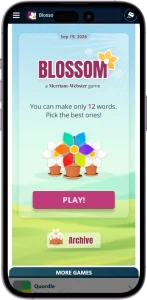
Best for: Players who enjoy maximizing a score
Merriam-Webster’s Blossom presents seven letters and allows you to submit 12 words. Longer words score more points, while bonus letters and pangrams can increase your total.
The 12-word limit adds strategy. Entering every short word you notice may prevent you from using a longer and more valuable answer later.
Why you may like it:
- Every submitted word matters.
- Longer answers receive better rewards.
- The daily game has a defined finish.
- It combines vocabulary with score management.
Blossom is one of the more strategic other Wordle game alternatives, particularly for players who enjoy Spelling Bee but want a clearer endpoint.
Best Connections Alternatives for Category-Puzzle Fans
The strongest Connections alternatives preserve the satisfaction of discovering relationships between words. Some follow the familiar four-group structure, while others introduce decoys, community-created clues, or multiple difficulty settings.
6. PuzzGrid
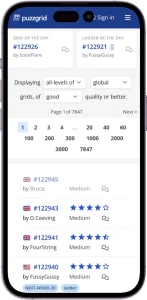
Best for: Players who want more connecting-wall puzzles
PuzzGrid is one of the closest browser-based games like Connections. A typical puzzle presents 16 clues that must be separated into four related groups of four.
The basic objective is familiar, but PuzzGrid relies heavily on community-created boards. Its puzzles can include specialist subjects, regional references, abbreviations, homophones, and deliberately misleading overlaps.
You can play a featured grid or explore a large collection of user-submitted puzzles. Quality and difficulty may vary, but the number of available boards makes PuzzGrid useful if one category puzzle per day is not enough.
Why you may like it:
- It uses a familiar four-by-four structure.
- A large collection of community-created grids is available.
- Difficulty ranges from approachable to highly specialized.
- Players can create and submit their own puzzles.
Because users write the grids, some categories may feel more subjective or niche than those in a professionally edited puzzle. Ratings and featured selections can help you find stronger boards.
7. Red Herring
Best for: Category puzzles on a phone or tablet
Red Herring asks you to organize related words while avoiding choices designed to mislead you. According to its App Store listing, the game has no time limit and offers multiple difficulty levels.
The challenge is not simply finding one possible relationship. You also need to check whether the remaining words can form complete categories. A tempting group may contain one word that belongs more convincingly somewhere else.
Red Herring is a practical choice for mobile players who want more games like Connections. Availability may differ by device, operating system, or region.
Meaning-Based Daily Word Games
8. Contexto
Best for: Lateral thinking and word associations
Contexto asks you to identify a hidden word using meaning-based feedback. It does not reveal correct letters or letter positions. Instead, each guess receives a ranking based on how closely it relates to the target word.
For example, if the answer relates to cooking, guesses such as “kitchen,” “oven,” and “recipe” may move you closer even though they do not contain the same letters.
Contexto rewards broad associations. You might begin with a general topic, discover a promising group of words, and gradually narrow the concept until you reach the intended answer.
Semantic rankings are based on patterns in language data, so some relationships may feel less intuitive than human-written clues. Treat the ranking as guidance rather than a perfect definition of how two words relate.
9. Semantle
Best for: Players who enjoy difficult, open-ended deduction
Semantle also uses semantic similarity rather than spelling-based feedback. You enter words and use their relative closeness to work toward the daily answer.
The search space is much broader than it is in Wordle. A close guess could be a synonym, an associated object, an action, or a word that frequently appears in a similar context.
Semantle can take longer than many daily word games. It may not be ideal when you only have a few minutes, but it works well for players who enjoy experimenting and returning to a difficult puzzle later.
Geography Games With a Wordle-Style Format
10. Worldle
Best for: Learning country shapes and locations
Worldle displays the silhouette of a country or territory and gives you six attempts to identify it.
After an incorrect guess, the game provides:
- The distance between your guess and the answer
- An arrow pointing in the general direction of the target
- A proximity percentage showing how close you are
This feedback makes Worldle approachable even when you do not immediately recognize the country’s shape. Every unsuccessful guess can help you move toward the correct part of the world.
Worldle also offers optional bonus rounds involving capitals, flags, borders, and related geographic facts. Some archives and additional features may require an account or paid access.
11. Globle
Best for: Hot-and-cold geography guessing
Globle hides a country somewhere on an interactive globe. Each incorrect guess appears in a color indicating how close that country is to the target.
Unlike Worldle, Globle does not begin with a silhouette. Your first answer acts as a geographic probe. From there, you move between countries based on whether the feedback becomes warmer or colder.
The game can be challenging when the answer is a small or less familiar country. It can also help players become more familiar with regions, borders, and relative locations.
Crossword and Word-Logic Games
12. Knotwords
Best for: Crossword fans who prefer logic over trivia
Knotwords combines crossword-style word building with letter-placement logic. Different sections of the grid provide groups of letters, and you arrange them so every horizontal and vertical entry forms a valid word.
The main format does not rely on traditional crossword clues. Instead, the available letters and intersecting answers gradually narrow the possible solutions.
Knotwords may appeal to players who enjoy crosswords but do not want to depend heavily on pop culture, historical references, or specialist trivia. Puzzle access and availability vary by platform and version.
13. Minute Cryptic
Best for: Learning cryptic crosswords one clue at a time
Minute Cryptic presents one cryptic clue per day, supported by hints and explanations.
A cryptic clue generally offers two routes to the same answer:
- A direct definition
- A form of wordplay
The wordplay might involve an anagram, reversal, hidden word, abbreviation, or another instruction indicated within the clue.
A complete cryptic crossword can feel overwhelming if you are unfamiliar with these conventions. Minute Cryptic makes the format more approachable by focusing on one small puzzle and explaining how its parts work.
It is a good option if your favorite part of Connections is the moment when an unexpected interpretation suddenly makes sense.
How to Choose the Right Casual Puzzle Game
Different games test different skills. Use these recommendations to narrow your choices.
Choose Quordle for letter deduction
Quordle retains Wordle’s main mechanics but adds three more boards. It is a logical next step if the original puzzle no longer feels challenging enough.
Choose Waffle for visible information
Waffle gives you all the required letters at the beginning. You are solving placement and efficiency rather than searching the entire vocabulary for possible guesses.
Choose PuzzGrid for category recognition
PuzzGrid offers a large supply of category puzzles. Its community-created format also introduces more subjects and difficulty levels than a single daily board.
Choose Contexto for word associations
Contexto focuses on meaning rather than spelling. It rewards flexible thinking and the ability to move between related concepts.
Choose Worldle for geography
Worldle follows a familiar daily guessing format while testing country shapes, distances, and relative locations.
Choose Minute Cryptic to learn a new puzzle style
Minute Cryptic does more than test whether you know an answer. Its hints and explanations can help you understand how cryptic clues are constructed.
Tips for Solving Daily Games Like Wordle
Use information-rich opening guesses
In Wordle-style games, an opening word containing several common letters may provide more information than one with repeated characters.
There is no universally perfect starting word. The best choice depends on the game’s rules, possible answer list, and whether your goal is to solve quickly or eliminate as many letters as possible.
Check the remaining clues before submitting a group
In Connections-style games, finding four related words does not automatically mean you have identified the intended category.
Before submitting, review the remaining clues. If they no longer appear capable of forming complete groups, reconsider your selection.
Treat incorrect guesses as useful evidence
A wrong answer can still move you forward:
- Quordle reveals letter information across four boards.
- Contexto indicates whether you are near a relevant concept.
- Worldle provides distance and direction.
- Globle shows whether you are geographically warmer or colder.
- PuzzGrid can reveal that an apparent connection is a red herring.
The most helpful guess is not always the one most likely to be correct. Sometimes it is the guess that removes the most uncertainty.
Take a break when you feel stuck
Daily puzzles are easy to overthink. Stepping away for a few minutes can help you notice a second definition, hidden phrase, or category you previously missed.
Use progressive hints when available
A small clue can keep the puzzle enjoyable without revealing the full solution. If a game provides several levels of assistance, begin with the least revealing hint.
Where Can You Play Free Wordle and Similar Games?
The official New York Times Wordle remains available as a daily game without a separate Games subscription.
The New York Times also currently lists Connections, Connections: Sports Edition, Strands, Pips, Sudoku, Crossplay, and limited Spelling Bee access among its free options. Some analysis tools, complete archives, and additional features require a qualifying subscription. The NYT Games subscription guide provides current access details.
If you are looking for free online games with a similar daily format, Quordle, Waffle, Contexto, Semantle, Worldle, Globle, and PuzzGrid generally provide some form of browser-based play.
“Free” does not always mean every feature is included. A game may charge for:
- Archive access
- Additional puzzle modes
- Advanced statistics
- Ad-free play
- Extra hints
- Account synchronization
In this context, free Wordle games means free Wordle-style puzzles and alternatives, not unofficial copies of the original game. Use the official website or a verified app-store listing whenever possible.
Do Browser Puzzle Games Need Fast Internet?
Browser puzzle games such as Wordle, Quordle, Waffle, and PuzzGrid generally use much less bandwidth than cloud gaming, video streaming, or downloading a large PC game. A very fast internet plan is usually unnecessary.
If several puzzle websites load slowly, possible causes include:
- An unstable Wi-Fi signal
- Browser extensions or corrupted cached data
- DNS problems
- A temporary website outage
- Router congestion
- A weak wireless signal in part of your home
TechPrim’s guide on how to fix slow internet can help you identify where the slowdown occurs. You can also learn how to reduce internet latency or review what internet speed you need for gaming and streaming before paying for a faster plan.
Are Wordle and Connections Brain Games?
Wordle, Connections, and similar titles are often described informally as brain games because they involve vocabulary, memory, pattern recognition, and logical deduction.
However, they should primarily be viewed as entertainment. Playing a daily puzzle may help you practice the specific skills used in that game, but it does not automatically improve general intelligence or prevent cognitive decline. Medical or long-term cognitive claims would require stronger scientific evidence.
The practical benefit is simpler: these games provide a structured reason to think carefully, test possibilities, and learn unfamiliar words or facts.
Frequently Asked Questions
What is the best game like Wordle?
Quordle is one of the closest alternatives because it uses five-letter answers and familiar color-coded feedback. Waffle is another strong option if you prefer rearranging existing letters instead of entering open-ended guesses.
What are the best free games like Wordle?
Quordle, Waffle, Contexto, Semantle, Worldle, Globle, and PuzzGrid are notable options with browser-based play. Free access, advertisements, account requirements, and premium features can change.
What other Wordle games can I play daily?
Other Wordle games include Quordle, Waffle, Blossom, Contexto, and Semantle. Strands, Worldle, and Knotwords are less direct alternatives, but they preserve the short and repeatable daily-puzzle experience.
What game is most similar to Connections?
PuzzGrid is one of the closest Connections alternatives because it asks you to separate 16 clues into four related groups. Red Herring provides another category-based option for supported mobile devices.
Are there Wordle alternatives that are not about words?
Yes. Worldle and Globle focus on countries and geography. Similar daily formats are also available for music, movies, sports, math, and historical events.
What are the best casual puzzle games for short breaks?
Wordle, Waffle, Connections, PuzzGrid, and Worldle work well as casual puzzle games because their basic rules are easy to understand and a daily round usually does not require a major time commitment.
Are browser puzzle games free?
Many browser puzzle games provide at least one free daily challenge. However, archives, advanced statistics, extra hints, premium modes, and ad-free access may require an account or payment.
Are Wordle and Connections still free?
The New York Times currently lists Wordle and Connections among the games available without a separate Games subscription. Certain archives, companion tools, and analysis features require a qualifying subscription.
Do daily word games improve vocabulary?
They may introduce you to unfamiliar words and encourage you to think about spelling, definitions, and associations. Their educational value depends on the game, its accepted word list, and whether you look up words you do not recognize.
Can children play these games?
Many of these games have simple controls, but difficulty and subject matter vary. Waffle and geography games may be approachable for younger players, while PuzzGrid and cryptic clues can depend on specialized vocabulary or cultural knowledge. Adults should review individual games when choosing puzzles for children.
Final Thoughts
There is no shortage of fun games to play daily if you enjoy short, focused challenges. Quordle offers a familiar but more demanding Wordle format, while Waffle turns letter placement into a compact logic puzzle. PuzzGrid and Red Herring are strong choices for players searching for games like Connections.
For something different, Contexto explores relationships between meanings, Worldle tests geographic reasoning, and Minute Cryptic introduces a new style of wordplay one clue at a time.
You do not need to play every option. Choose two or three games that test different skills. A routine combining Wordle, PuzzGrid, and Worldle, for example, provides letter deduction, category recognition, and geography in three short rounds.
These games may be described as brain games, but their clearest value is simple: they are entertaining, accessible, and easy to make part of a daily routine.
For more practical gaming, internet, and technology guides, visit TechPrim.
You May Also Like
 Computers & PC Games
Is Minecraft Dungeons Cross-Platform? Here’s How It Works
 Computers & PC Games
8 Best Valheim Server Hosting Providers in 2026
 Computers & PC Games
How Much RAM Do You Need for a Minecraft Server?
 Computers & PC Games
Valheim Server Requirements: CPU, RAM, Storage, Bandwidth, and Performance Tips
 Computers & PC Games
10 Best Modded Minecraft Server Hosting (2026): Pricing, Specs & Honest Picks for Every Modpack
 Computers & PC Games