
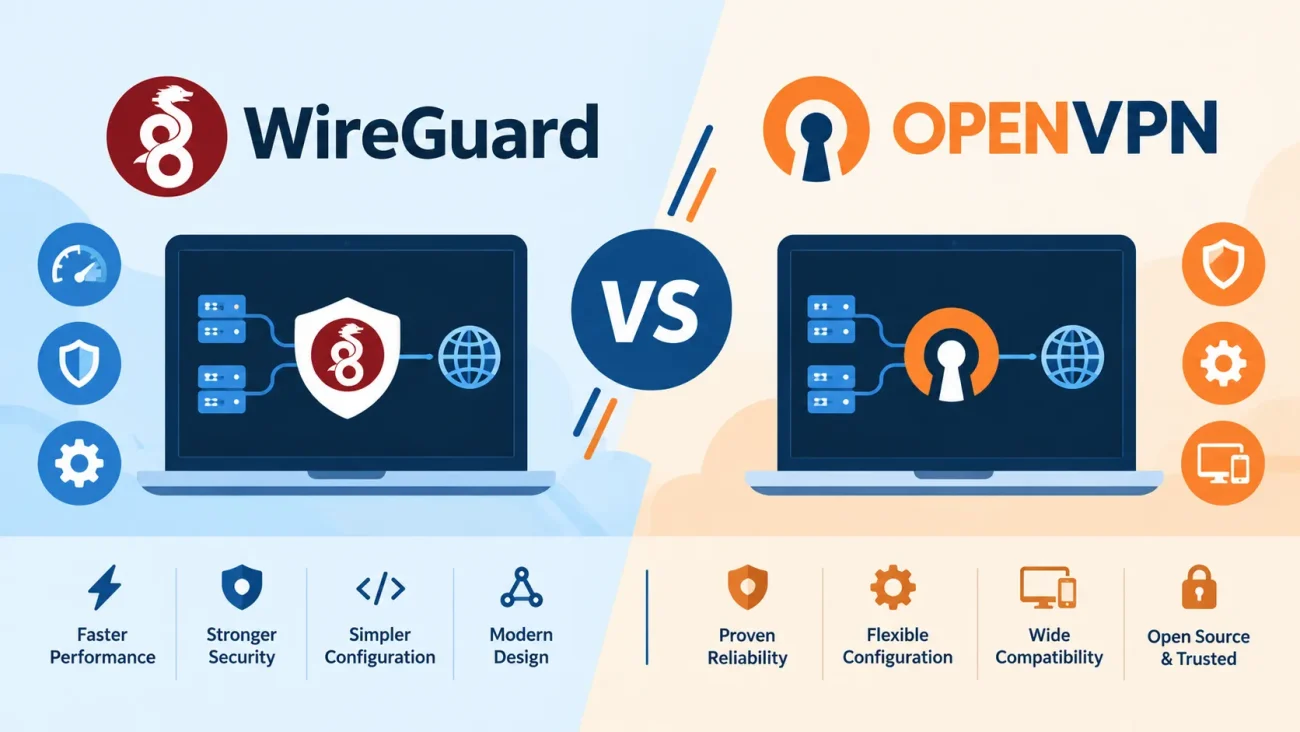
For many VPN users, the biggest difference between WireGuard and OpenVPN comes down to performance and design.
WireGuard is a newer protocol built around a small, streamlined codebase and a fixed set of modern cryptographic primitives. OpenVPN has been around much longer and takes a more flexible approach, supporting different transport and cryptographic configurations.
Neither protocol is automatically the best choice for everyone. Your VPN provider, server location, device, network conditions, and configuration can affect the experience just as much.
In this guide, we’ll explain how WireGuard and OpenVPN work, how they differ in speed, security, privacy, compatibility, and configuration, and which one makes the most sense for different situations.
What Is a VPN Protocol?
A VPN protocol is the set of rules and technologies a VPN uses to establish a connection, authenticate the endpoints, encrypt traffic, and move data between your device and the VPN server.
A simple way to think about it is that the VPN provides the encrypted tunnel, while the protocol determines how that tunnel is created and how traffic moves through it.
Some protocols prioritize simplicity and performance. Others provide more configuration options for different networks and use cases.
Two of the most widely used VPN protocols are WireGuard and OpenVPN.
What Is WireGuard?
WireGuard is a modern VPN protocol designed around simplicity, a relatively small codebase, and modern cryptography.
It uses a fixed cryptographic design that includes ChaCha20 for encryption, Poly1305 for authentication, and other modern primitives for key exchange and hashing.
Unlike protocols that support many interchangeable cryptographic options, WireGuard intentionally limits the choices available. This reduces configuration complexity and gives the protocol a more focused design.
WireGuard is also known for strong performance. In many real-world tests, it can outperform OpenVPN, particularly on modern hardware and fast connections.
However, that does not mean every WireGuard connection will be faster. Server distance, congestion, device hardware, routing, and the VPN provider’s implementation can all change the result.
What About NordLynx?
Some VPN providers build additional technology around WireGuard rather than offering the protocol completely unchanged.
NordLynx is NordVPN’s WireGuard-based implementation. NordVPN developed additional network architecture around WireGuard to address aspects of privacy and connection management while keeping the protocol’s performance advantages.
This distinction is important when reading VPN speed tests. A result for NordLynx is a result for NordVPN’s implementation of WireGuard, not a universal benchmark for every WireGuard VPN.
How Does WireGuard Work?
WireGuard creates an encrypted tunnel between a VPN client and a VPN server.
The client uses cryptographic keys to authenticate the connection, while network traffic sent through the tunnel is encrypted and authenticated.
One of WireGuard’s main design differences is its simplicity. Instead of supporting a large collection of cryptographic algorithms and configuration options, it uses a relatively fixed set of modern primitives.
WireGuard is also implemented differently depending on the operating system. On Linux, it is integrated into the kernel, while other platforms use their own implementations.
This streamlined architecture can reduce overhead and make the software easier to maintain and review.
What Is OpenVPN?
OpenVPN is a mature, widely deployed VPN protocol known for its flexibility and compatibility.
It uses TLS for authentication and key exchange and can support different encryption and authentication configurations.
OpenVPN can operate over both UDP and TCP, which gives providers and administrators more flexibility when dealing with different network environments.
Its long history is another advantage. OpenVPN has been used across desktops, mobile devices, routers, firewalls, and enterprise networks for many years.
The trade-off is complexity. OpenVPN provides more configuration options than WireGuard, which can be useful in specialized environments but also creates more choices to manage.
How Does OpenVPN Work?
OpenVPN creates an encrypted tunnel between a VPN client and server.
During the connection process, the client and server authenticate one another and establish the cryptographic parameters used to protect the connection. Network traffic is then routed through the encrypted tunnel.
OpenVPN can use either UDP or TCP.
- UDP generally has less transport overhead and is often preferred when responsiveness and performance are important.
- TCP can be useful in networks where TCP-based connections work more reliably or where UDP traffic is restricted.
That does not make TCP inherently “more stable” or UDP inherently “faster” in every situation. The actual result depends on the network, configuration, packet loss, and surrounding conditions.
WireGuard vs. OpenVPN: Key Differences
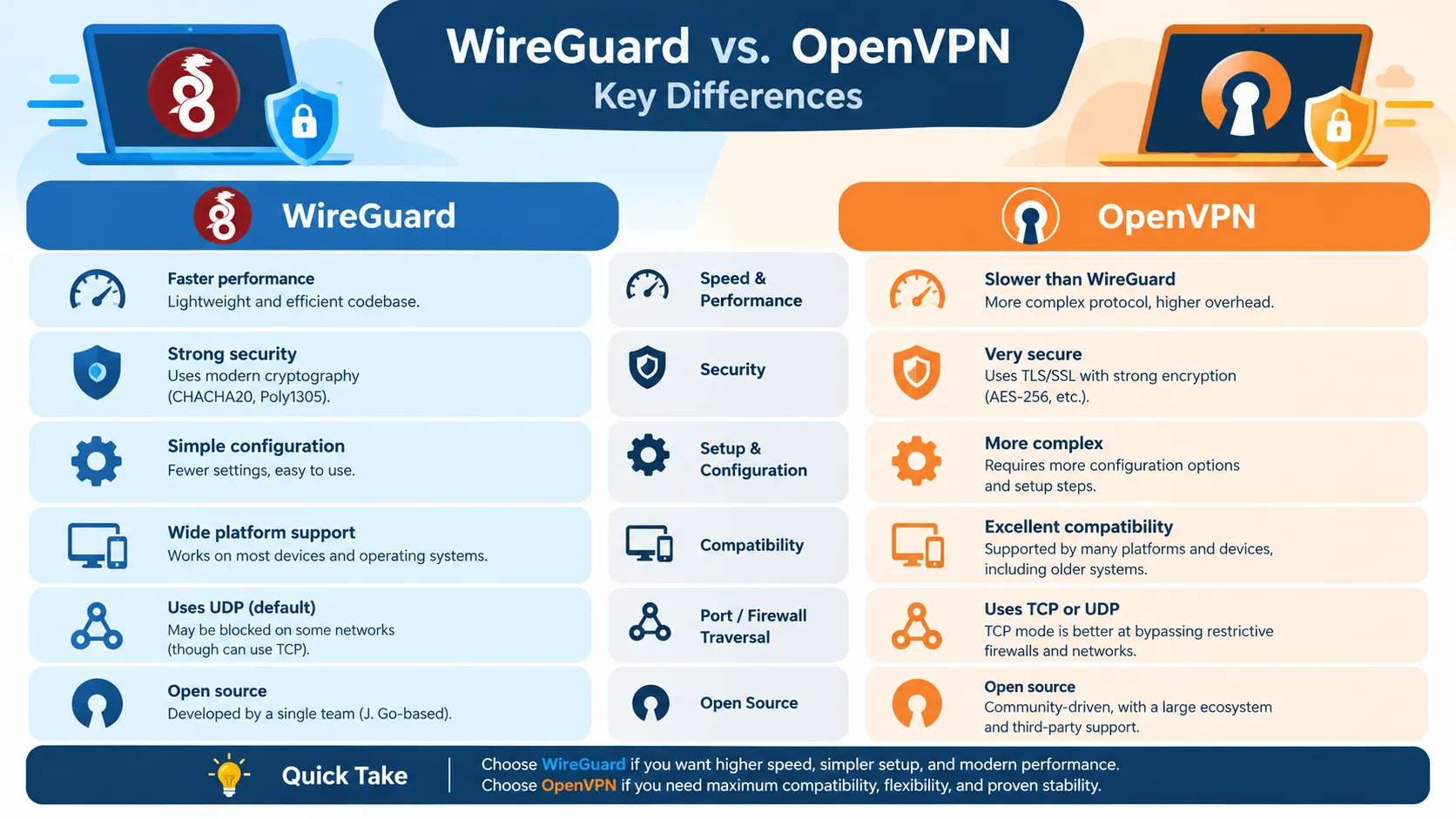
The biggest differences are in their design philosophy, cryptographic configuration, transport options, complexity, and typical performance.
| Feature | WireGuard | OpenVPN |
|---|---|---|
| Design | Streamlined and opinionated | Flexible and highly configurable |
| Performance | Often very fast with relatively low overhead | Can be slower depending on configuration and hardware |
| Cryptography | Uses a fixed modern cryptographic design | Supports multiple cryptographic configurations |
| Transport | UDP-based | Supports UDP and TCP |
| Codebase | Relatively small | Significantly larger |
| Configuration | Fewer choices | Many configuration options |
| Compatibility | Broad support on modern platforms and devices | Very broad support, including many routers and networking platforms |
| Customization | Limited by design | Extensive |
| Mobile use | Often efficient on modern devices | Can require more processing depending on configuration |
| Best known for | Simplicity and performance | Flexibility and compatibility |
There is no single winner. WireGuard is often a good fit when you want a simple, modern protocol with strong performance. OpenVPN remains useful when compatibility, transport flexibility, or detailed configuration matters more.
WireGuard vs. OpenVPN: Speed
Speed is one of WireGuard’s strongest advantages in many comparisons.
Its streamlined design and modern implementation can reduce overhead, which can be particularly noticeable on fast connections where the VPN protocol itself becomes part of the performance equation.
Still, protocol choice is only one piece of the puzzle.
Your actual VPN speed can depend on:
- Server distance: A farther server generally means more network delay and can affect throughput.
- Server load: A busy VPN server can reduce performance.
- Your internet connection: A VPN cannot provide more bandwidth than your connection and network path can deliver.
- Device hardware: Encryption and packet processing use CPU resources.
- Network congestion: Busy links can affect both throughput and latency.
- VPN provider infrastructure: Server capacity, routing, and implementation quality matter.
- Test methodology: Different benchmark tools and test locations can produce different results.
So the safer conclusion is that WireGuard often performs better than OpenVPN in comparable conditions, but the size of the difference varies.
NordLynx vs. OpenVPN: Real-World Speed Tests
Third-party testing can illustrate the difference, but individual results should not be treated as universal benchmarks.
In one TechRadar test using a 10 Gbps connection, NordVPN reached:
- 1,256 Mbps with NordLynx
- 974 Mbps with OpenVPN
That was a difference of 282 Mbps, making NordLynx about 29% faster in that particular test.
CyberInsider reported a larger gap in its testing. It measured 903 Mbps for NordLynx and reported that OpenVPN was about 57% slower on average.
Those results point in the same general direction, but they do not mean that every WireGuard connection will outperform every OpenVPN connection by the same percentage.
The tests used specific devices, servers, networks, and methodologies. Change those variables and the result can change too.
The useful takeaway is that NordLynx gave NordVPN more speed headroom than OpenVPN in those tests.
OpenVPN can still be fast enough for activities such as streaming, gaming, and video calls. The difference tends to become more noticeable on faster internet connections.
WireGuard vs. OpenVPN: Security
Both WireGuard and OpenVPN are widely used VPN protocols with strong security designs.
The biggest difference is their approach to cryptography and configuration.
WireGuard uses a relatively fixed set of modern cryptographic primitives. You do not normally choose from a long list of encryption combinations.
That opinionated design reduces configuration complexity and limits the possibility of accidentally choosing an outdated or inappropriate cryptographic setup.
OpenVPN is more flexible. Its design supports different encryption and authentication configurations, which can be valuable when a particular network or deployment has specific requirements.
That flexibility also means configuration matters more.
It would therefore be misleading to describe WireGuard as “secure” and OpenVPN as “less secure.”
A better comparison is:
- WireGuard: modern, streamlined cryptographic design with fewer configuration choices.
- OpenVPN: mature, flexible design with more configuration options.
Both can provide strong security when properly implemented and maintained.
WireGuard vs. OpenVPN: Codebase and Complexity
One of WireGuard’s most notable characteristics is its relatively small implementation.
The protocol was deliberately designed to avoid many layers of legacy complexity and unnecessary features. This makes the implementation easier to study compared with much larger VPN software projects.
OpenVPN has a considerably larger codebase. That reflects its long history, extensive feature set, compatibility requirements, and configuration flexibility.
A smaller codebase does not automatically make software safer. However, less implementation complexity can make security review and maintenance more manageable.
In practical terms:
- WireGuard favors simplicity.
- OpenVPN favors flexibility.
Neither approach is inherently wrong. They are designed for different priorities.
WireGuard vs. OpenVPN: Privacy
The VPN protocol is only one part of your privacy model.
Both WireGuard and OpenVPN encrypt traffic between your device and the VPN server. What happens to your data beyond that point depends heavily on the VPN provider.
Before choosing a provider, consider:
- Logging practices: What connection or activity information is collected?
- Data retention: How long is that information kept?
- Ownership: Who operates the VPN service?
- Jurisdiction: Where is the provider based?
- Audits: Has an independent organization reviewed relevant privacy or security claims?
- Infrastructure: How is the provider’s network operated and secured?
WireGuard also has some design considerations around connection state and IP address management that providers need to handle appropriately.
This is one reason some VPN companies build additional systems around WireGuard. NordLynx, for example, adds provider-specific infrastructure around WireGuard rather than representing the protocol alone.
The important point is that choosing WireGuard does not automatically make one VPN provider more private than another.
WireGuard vs. OpenVPN: Battery Usage
WireGuard’s lightweight design can make it a good choice for phones, tablets, and other devices where CPU usage and battery consumption matter.
In practice, however, battery life depends on much more than the protocol.
Your device hardware, VPN app, network quality, server distance, connection stability, and online activity can all affect power consumption.
OpenVPN can also work well on mobile devices. Its performance varies depending on the implementation, transport, encryption settings, and hardware.
So rather than promising a specific battery-life advantage, it is more accurate to say that WireGuard is often an efficient option on modern mobile devices.
WireGuard vs. OpenVPN: Compatibility
OpenVPN has an advantage when you need broad compatibility or detailed configuration.
It has been supported for years across operating systems, routers, firewalls, and other networking equipment. That makes it particularly useful in environments built around established OpenVPN configurations.
WireGuard is also widely supported on modern platforms, including desktop and mobile operating systems.
However, its more focused design means it does not provide the same range of transport and configuration choices as OpenVPN.
For everyday users with a modern VPN app, this difference may not matter much. For advanced networking environments, it can.
WireGuard vs. OpenVPN: UDP and TCP
One major technical difference is transport support.
WireGuard uses UDP. It does not provide a TCP mode within the protocol itself.
OpenVPN supports both UDP and TCP.
UDP generally avoids some of the overhead associated with TCP and is well suited to interactive traffic.
TCP can be useful in environments where UDP traffic is blocked, restricted, or otherwise unsuitable.
However, running a VPN tunnel over TCP does not automatically make the connection faster or more reliable. In some conditions, it can introduce additional overhead and interactions with TCP congestion control.
This is one area where OpenVPN gives users more flexibility than WireGuard.
WireGuard vs. OpenVPN for Gaming
WireGuard can be a good option for gaming when it provides lower overhead or a better route to the game server.
But the VPN itself can also add latency because your traffic may travel through an additional server.
Server location therefore matters.
A nearby WireGuard server can outperform a distant OpenVPN server, but that does not prove WireGuard will always be faster for gaming.
For competitive games, test the protocol with the game and server region you actually use. Look at latency, jitter, packet loss, and consistency, not just download speed.
WireGuard vs. OpenVPN for Streaming
Both protocols can support video streaming.
For most users, either one can provide enough performance for common streaming resolutions when the underlying connection is fast enough.
WireGuard may offer more performance headroom on faster connections, especially when the VPN provider has well-optimized infrastructure.
OpenVPN can still perform well, particularly when the server is nearby and the connection is not heavily loaded.
If streaming performance is poor, check the VPN server location, server load, base internet connection, and network congestion before assuming the protocol is the only problem.
Is WireGuard Better Than OpenVPN?
There is no single answer.
WireGuard is usually the better starting point when you prioritize:
- Speed
- Simplicity
- Modern protocol design
- Lower configuration complexity
- Efficient performance on modern devices
OpenVPN may be the better choice when you need:
- TCP support
- More configuration options
- Compatibility with specialized equipment
- An established OpenVPN-based network
- More control over transport and cryptographic configuration
For many everyday VPN users, starting with WireGuard is reasonable.
For more specialized networking environments, OpenVPN can still be the more practical option.
Is WireGuard Faster Than OpenVPN?
Often, yes, but not in every situation.
WireGuard frequently performs better in comparable tests because its design and implementation can reduce overhead.
However, there is no universal speed difference that applies to every device and VPN server.
A nearby, lightly loaded OpenVPN server may outperform a distant or congested WireGuard server.
That is why a benchmark should be treated as an example rather than a promise.
Is WireGuard More Secure Than OpenVPN?
Not automatically.
Both protocols can provide strong security when properly implemented.
WireGuard’s main security advantage is arguably its simpler, more opinionated design. It offers fewer cryptographic configuration choices, which can reduce the chance of configuration mistakes.
OpenVPN gives administrators more flexibility, which can be useful in specialized environments but requires more configuration decisions.
The security of your actual VPN connection also depends on the software implementation, configuration, updates, and provider operating the service.
Is OpenVPN Still Worth Using?
Absolutely.
OpenVPN is not obsolete simply because WireGuard is newer.
Its flexibility, compatibility, and TCP support still make it useful for many users and organizations.
If your VPN provider gives you a choice, there is nothing wrong with testing both protocols.
In fact, comparing them on your own device and network can be more useful than relying on a generic benchmark.
Which VPN Protocol Should You Choose?
For most people, the decision can be simple.
Choose WireGuard when you want a modern, streamlined protocol and strong performance without needing extensive configuration.
Choose OpenVPN when you need broader configuration options, TCP support, or compatibility with equipment and networks that already use OpenVPN.
You can also use both when your VPN provider supports them.
A protocol is only one part of the overall VPN experience. Server location, network quality, provider infrastructure, device performance, and configuration can matter just as much.
The Bottom Line
WireGuard and OpenVPN are both capable VPN protocols, but they are designed with different priorities.
WireGuard emphasizes simplicity, modern cryptography, and performance. OpenVPN emphasizes flexibility, compatibility, and configuration options.
For many modern VPN users, WireGuard is the better starting point, especially when speed and simplicity are priorities.
OpenVPN remains a strong choice when you need TCP support, specialized compatibility, or more control over how the connection is configured.
The best choice is not necessarily the protocol with the highest benchmark number. A well-configured VPN with a nearby server can outperform a theoretically faster protocol running on a congested or distant server.
In the end, WireGuard vs. OpenVPN is less about finding one universal winner and more about choosing the protocol that fits your device, network, and priorities.
You May Also Like
 VPNs & Proxies
How to Hide Your IP Address and Protect It: 5 Best Ways
 VPNs & Proxies
The Netflix VPN Block: How to Fix the Proxy Detected Error
 VPNs & Proxies
Is It Legal to Use a VPN With Netflix?
 VPNs & Proxies
7 Reasons to Use a VPN: What It Changes, What It Doesn’t, and When It Helps
 VPNs & Proxies
What Is a VPN Kill Switch and Why Is It Important?
 VPNs & Proxies