
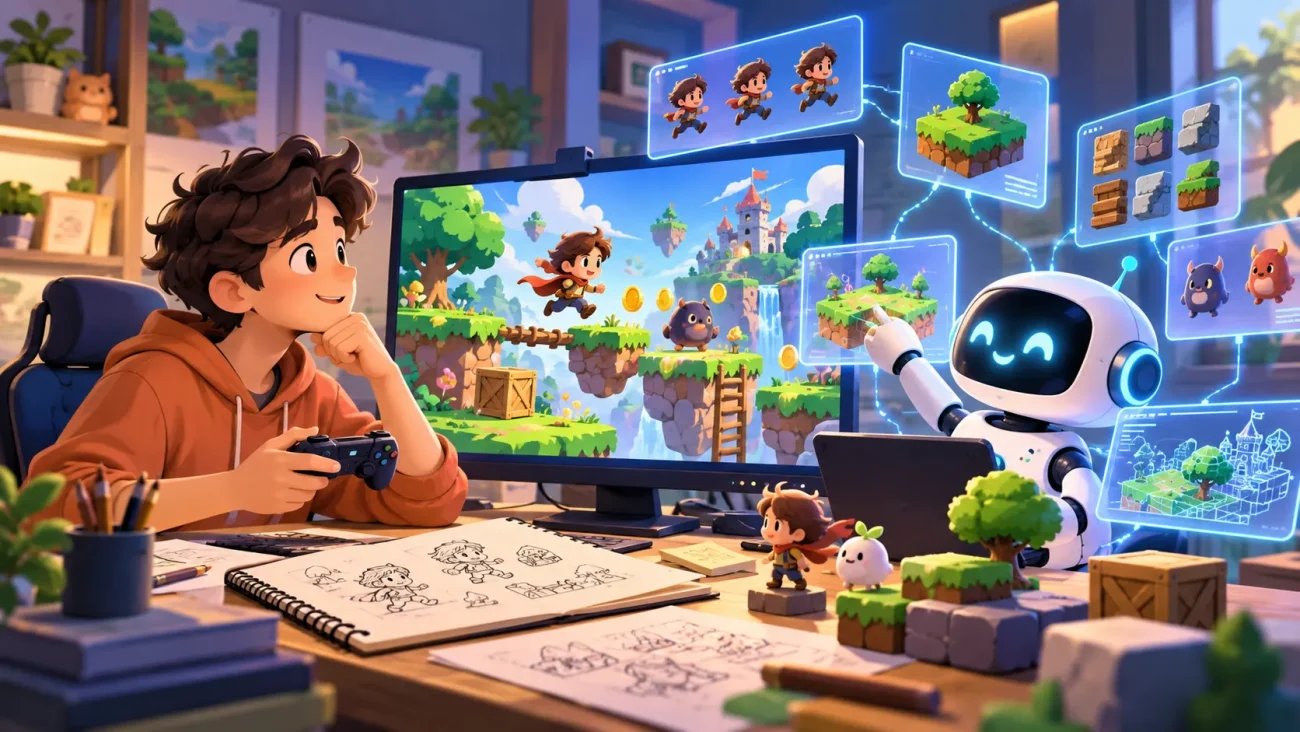
Will AI replace game developers? Probably not as a profession, but it is already changing how parts of game development get done. AI can help write code, generate visual ideas, draft dialogue, make animation starting points, and build prototypes. Some tasks and roles may face more disruption than others. But using AI to create part of a game isn’t the same as an AI independently designing, testing, and shipping a polished commercial release.
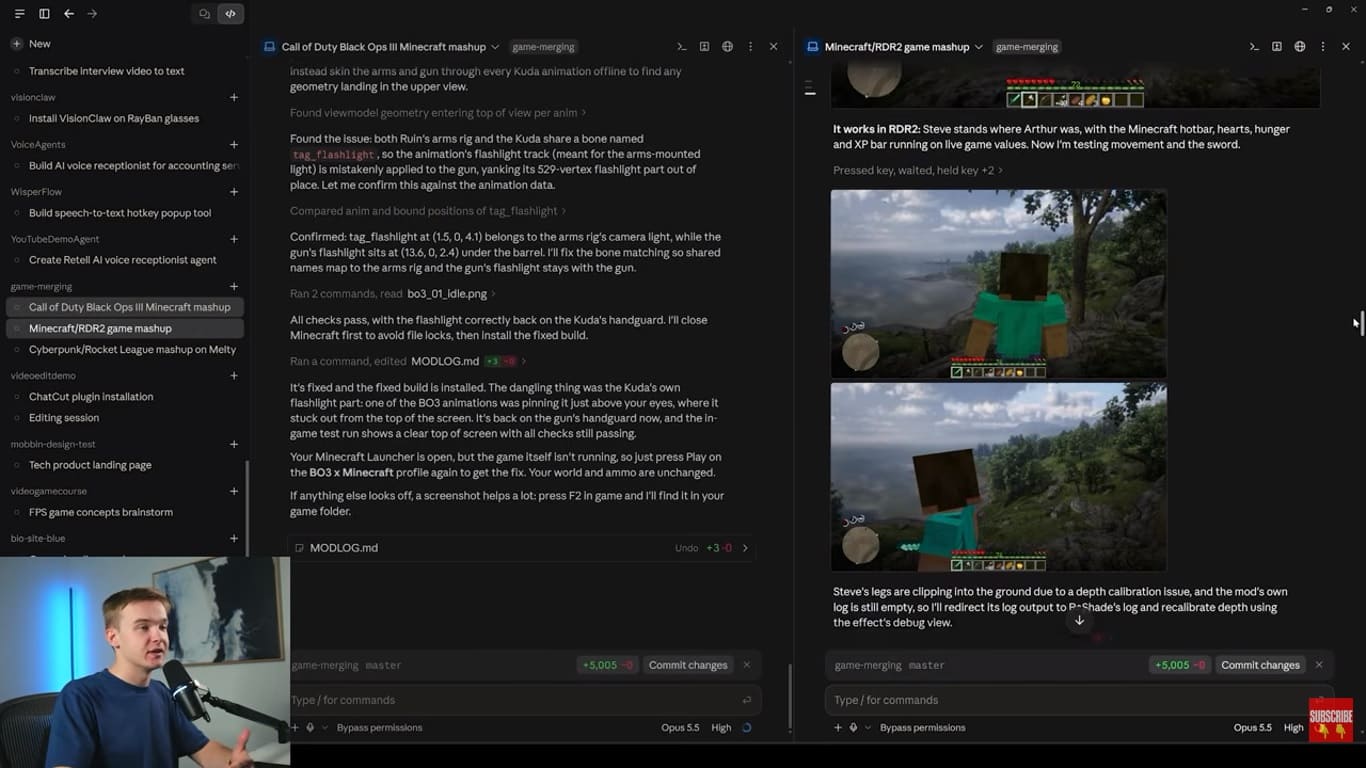
I’ll admit this question has started to feel more personal to me. I spend several hours a day watching videos about games built with AI, and some of them are startling. One that really caught my attention was Brendan Jowett’s “How To Merge Video Games With AI! (Full Tutorial)”. It shows a workflow that connects elements of Minecraft and Red Dead Redemption 2 using Claude Opus 5.5 and AI tools.
Seeing one creator demonstrate that mashup made me think: This is moving quickly. It also made me uneasy about what these tools could mean for people building games for a living.
There’s an important qualification. The video presents the workflow as requiring no manual coding. That doesn’t necessarily mean no code is involved: an AI agent may still generate or modify code behind the scenes. And a game mashup isn’t the same as merging two complete games into one new, standalone game. The demonstration is striking, but it doesn’t show that AI can replace a development team.
As a gamer, I find the distinction useful. A short video can show an impressive result, but it can’t tell me how much work happened behind the scenes, whether the experience holds up over hours of play, or whether it’s ready for release.
Will AI Replace Game Developers?
AI is more likely to change how game developers work than to eliminate game development as a profession in the near term. It can help produce drafts and speed up repeatable tasks. People still need to shape the game, connect its parts, test the result, and decide what’s ready to ship.
A game involves choices about player experience, technical systems, performance, quality, schedule, and budget. A feature that works in a small demo may fail when it meets online play, save systems, platform requirements, or the rest of a large project.
AI output needs review. Someone has to check whether code works, assets fit the art direction, dialogue stays consistent, and features are safe for players. How much work AI can take on depends on the task and the studio’s ability to evaluate the result.
Which Game Development Jobs Could AI Affect Most?
The table describes potential exposure to task-level automation, not a prediction that whole jobs will disappear. The impact will vary by studio, project, and quality requirements.
| Role or task | Potential AI impact | Why |
|---|---|---|
| Junior programming tasks | Higher | AI can draft boilerplate, explain code, and suggest fixes. Developers still need to review and integrate the output. |
| Concept art and visual ideation | Higher | Generative tools can produce rough options quickly; artists still choose and refine a direction. |
| Dialogue drafting | Higher | Models can create text variations, while writers manage voice, continuity, and story purpose. |
| Localization support | Moderate to high | AI can draft translations, but tone, context, humor, and cultural nuance need review. |
| QA support | Moderate to high | Automation can help with repeatable checks and test ideas, but not every kind of playtesting. |
| Technical art | Moderate | AI can assist with asset workflows; technical artists handle constraints, cleanup, and integration. |
| Game design | Moderate | AI can brainstorm and support prototyping, but designers test and balance ideas with players. |
| Lead engineering | Lower direct replacement risk | Architecture, performance, and complex debugging require broad technical judgment. |
| Creative direction | Lower direct replacement risk | The work involves setting a vision, making trade-offs, and aligning a team. |
| Producer or project leadership | Lower direct replacement risk | Priorities, communication, risk management, and business decisions remain central. |
These categories describe which tasks may change—not which jobs are guaranteed to be safe or eliminated.
What Can AI Already Do in Game Development?
Current tools can assist with specific production tasks, but most examples remain human-guided. They can generate or revise material without independently managing every stage of development.
- Code assistance and prototyping: Coding tools can suggest code, explain unfamiliar sections, draft features, and help create tests. Unity’s AI tools include an Editor assistant that can inspect scenes and components. Epic’s Developer Assistant for Unreal Engine can answer engine questions, though Epic notes it may make mistakes.
- Test generation: AI can suggest test cases. GitHub’s Copilot documentation shows Copilot helping with unit and integration tests, which developers still need to review and run.
- Materials and visual exploration: Adobe Substance 3D Sampler can use machine learning to generate material maps from an image. This gives artists a starting point, not a finished decision about style or in-game performance.
- Animation assistance: Autodesk’s MotionMaker for Maya can generate character movement from keyframes or a motion path for animators to direct and refine.
- Dialogue and writing: Language models can draft quest lines, item descriptions, or dialogue variations. Writers check that the text fits the characters and story.
- NPC experiments: NVIDIA ACE offers tools for building conversational or action-oriented characters. These are components for specific projects, not proof that any game can support unlimited, reliable AI conversations.
- Localization support: AI can draft translations, while human reviewers check idioms, tone, character voice, and story context.
The 2026 GDC State of the Game Industry report says 30% of respondents at game studios reported using generative AI tools as part of their job. That measures reported use; it does not show how much time the tools save, whether they improve games, or how many jobs they affect.
What the Game-Making Videos Show and What They Don’t
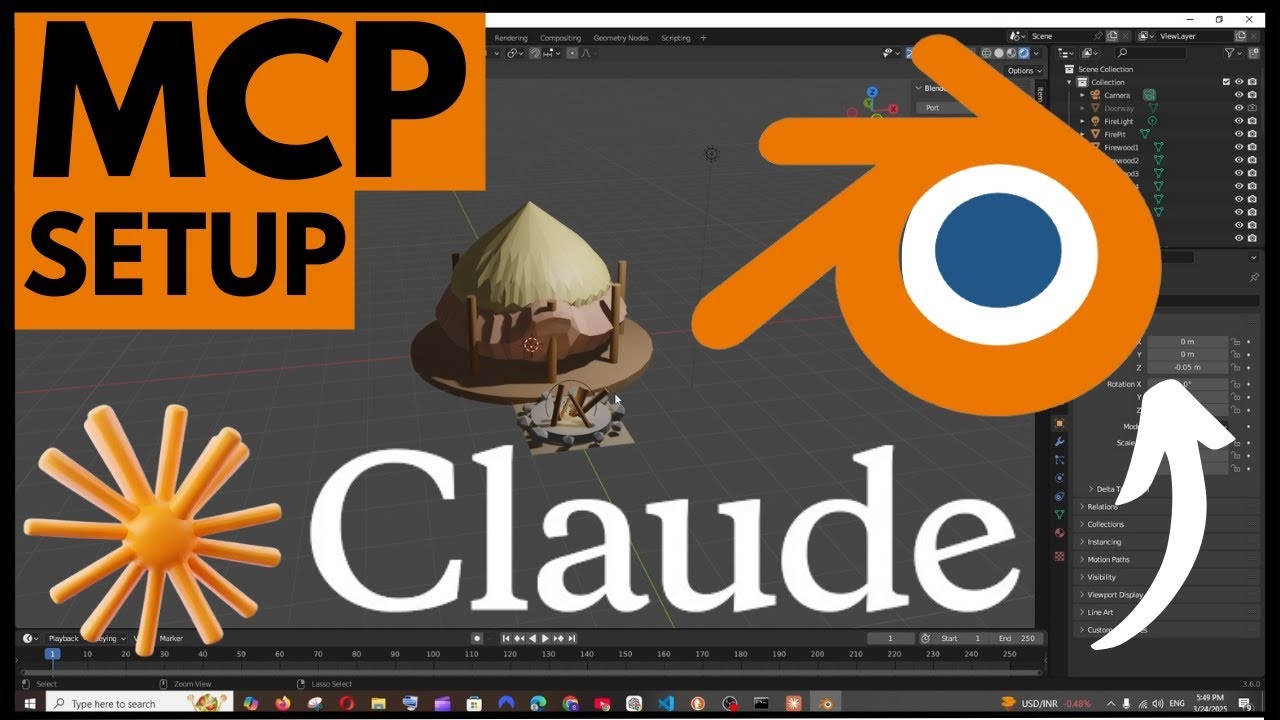
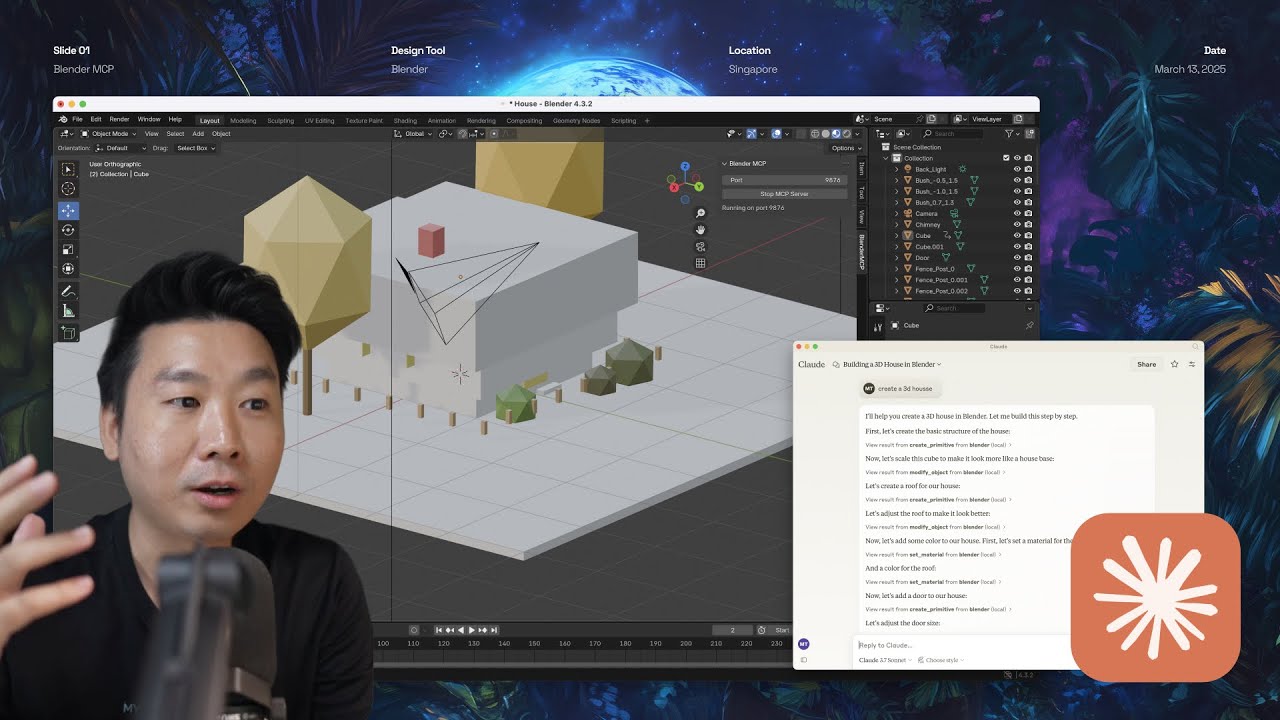
MCP stands for Model Context Protocol. The third-party MCP for Blender project connects compatible AI clients to Blender so they can interact with a scene through available tools. A creator can ask an AI assistant to help make or change scene elements, then inspect the result.
That’s different from asking a chatbot for advice, and it helps explain why these demos feel like a step forward. But the connection doesn’t guarantee clean topology, a production-ready rig, consistent art direction, or assets ready to ship. The creator still needs to review the work and fix problems.
Brendan Jowett’s game-mashup tutorial is one creator-led example. Others include AI Oriented Dev’s 3D game video, Web3World’s “AI Built My Entire Game, Then Played It Itself”, and PixelLab’s Godot and Claude Code workflow.
I find these videos useful because they show what creators are attempting. But they aren’t controlled studies or independent audits. They don’t necessarily reveal failed attempts, off-camera corrections, or whether a game is polished enough for a commercial release.
The model names can also be confusing. Anthropic’s official names include Claude Opus 5.5 and Claude Sonnet 5.5. OpenAI’s are GPT-6 Astra and GPT-6.1 Sol—sometimes searched informally as “Astra 6” and “GPT Sol 6.1.” A model name or vendor benchmark doesn’t establish that it’s the best choice for game development; results depend on the task, tools, project context, and review process.
Tools such as Seedance 2.5 can support video-generation work, such as promotional clips or visual experiments. That may help around a game’s production, but making an ad is different from making a playable, tested game.
What AI Still Struggles With in Game Development
AI can produce plausible work that is still wrong, inconsistent, or unsuitable for a project. Its usefulness depends on whether the team can check and integrate the output.
Generated code may use an incorrect function, misunderstand an engine version, or solve the wrong problem. A snippet that works by itself may break when it interacts with networking, saving, animation, or other systems.
Creative output can also lack consistency. Concept images may not share a coherent character design; dialogue may contradict an earlier scene; animation may need changes to fit a character or mechanic.
Studios must also consider performance, memory, production-pipeline compatibility, player safety, and rights to inputs and outputs. The U.S. Copyright Office’s 2025 report on AI and copyrightability says copyright questions depend on human contribution and the details of a work. It doesn’t settle every legal or licensing question a studio may face.
Will AI Replace Programmers, Artists, or Designers?
AI is more likely to change these jobs than to remove the need for them entirely. Each role involves important work beyond producing a first draft.
- Programmers still make architecture decisions, handle networking and memory, optimize performance, investigate hard bugs, and maintain systems. AI can write code, but reviewing it requires engineering knowledge.
- Artists shape a visual language, keep characters recognizable, meet technical limits, and integrate assets into the game. Generative tools can help with exploration, references, variations, and some texture or animation tasks.
- Designers work on core loops, progression, difficulty, tutorials, accessibility, economies, multiplayer rules, and player feedback. AI can suggest ideas; designers test and balance them with players.
For aspiring developers, fundamentals remain important. If you can’t read the output, reproduce a bug, or explain why a system behaves as it does, an AI assistant may help you produce problems faster—not solve them.
Is AI Going to Take Game Development Jobs?
Some tasks or roles may shrink or change, but current evidence doesn’t show that AI is replacing game developers as a whole. A nearer-term possibility is that studios expect teams to produce more, hire differently, or automate some repetitive work.
The game industry is already facing employment uncertainty. GDC’s 2026 report says 28% of respondents had been laid off in the previous two years, and 74% of surveyed students were concerned about future job prospects. Those figures show concern, but they don’t prove AI caused the layoffs.
Employment projections offer context, not a game-industry forecast. The U.S. Bureau of Labor Statistics projects 10% growth from 2025 to 2035 for the broad category of software developers, QA analysts, and testers. For special effects artists and animators, it projects 2% growth from 2024 to 2034 and notes AI-produced routine tasks may dampen demand. Neither category isolates video game development.
What Happens to Junior Developers and Small Studios?
Junior developers may face added pressure because AI can help with simple, well-defined tasks. Boilerplate code, basic scripts, documentation, and first-pass debugging are examples. Entry-level roles could change if studios automate some of this work.
But teams still need people who can learn a codebase, check AI output, handle integration, and grow into more complex work. Employers may expect junior hires to become productive faster; whether this becomes a broad industry trend is uncertain. A portfolio that shows how you debugged, tested, and made design choices can help demonstrate those skills.
For small studios, AI can help explore concepts, create temporary assets, automate routine checks, or prototype a feature. It may reduce friction, but it doesn’t automatically make development cheaper. Review, integration, tool fees, quality control, and distribution still take time and resources.
How Game Developers Can Adapt to AI
Learn to use AI, and build the skills needed to judge its output. In practice, that means:
- Use AI to draft a small feature, then test it and make sure you understand it.
- Practice debugging: reproduce issues, read logs, isolate causes, and verify fixes.
- Learn how gameplay, UI, saving, networking, and performance affect one another.
- Develop a creative point of view and be able to explain why an idea fits the game.
- Use AI for bounded tasks, such as suggesting tests for one feature, then run and improve those tests yourself.
- Check studio policies and asset provenance before using generated material.
AI familiarity is useful; it isn’t a substitute for learning how to make and evaluate games.
AI-Assisted Development vs. Fully AI-Generated Games
These phrases describe different levels of automation:
- AI-assisted development: A person uses AI for a defined task, such as drafting code, generating material maps, or creating animation to refine.
- Highly automated development: Software handles more repeatable steps, while people set goals and review the work.
- Fully AI-generated development: An AI independently designs, builds, tests, balances, optimizes, ships, markets, and maintains a commercial game.
Most examples in this article fit the first category. A compelling prototype or game mashup is not the same as an AI independently building a complete game.
What Might Game Development Look Like in the Future?
Several outcomes are plausible, and they may happen at the same time:
- AI becomes a standard tool for code, research, testing, and asset workflows.
- Smaller teams use it to prototype or produce more content.
- Some repetitive production tasks require fewer hours or workers.
- Teams develop new responsibilities around AI integration, evaluation, and AI-driven game systems.
Which outcomes become common will depend on tools, budgets, hiring, and player demand.
Will AI Replace Game Developers? Final Verdict
Probably not in the sense of replacing game developers as a whole. AI is already speeding up or automating some tasks, and certain roles may face more disruption than others.
I still find the new game-making videos startling—and sometimes unsettling. But the Brendan Jowett demo is best understood as a striking example of AI-assisted experimentation, not proof that an AI can run a game studio. Building a compelling prototype and shipping a polished game are different challenges.
FAQ
Will AI completely replace game developers?
Probably not in the near term. AI can help with specific tasks, but games still require creative decisions, engineering, testing, and accountability.
Will AI take game development jobs?
It may change hiring and reduce some repetitive work, but the scale of future job losses is uncertain. Current data shows adoption and employment concerns, not a reliable count of jobs AI will replace.
Can AI make a complete video game?
AI can help create prototypes and game components, but that’s not the same as independently building and shipping a polished commercial game. Testing, integration, optimization, and maintenance remain substantial challenges.
Should aspiring game developers learn AI?
Yes, as a tool, not a substitute for learning development. Practice using AI for specific tasks, then build the skills needed to judge its results.
You May Also Like
 AI
AIThe Uncanny Match: How We Learned to Spot AI-Generated Photos on Dating Apps
 VPNs & Proxies
What Is a VPN Kill Switch and Why Is It Important?
 Internet
The Best Places to Put a WiFi Extender in a 2-Story House
 Computers & PC Games
What Is 4K Resolution on a Monitor?
 Internet
How to Fix Slow Internet: 15+ Things That Actually Work
 Internet