
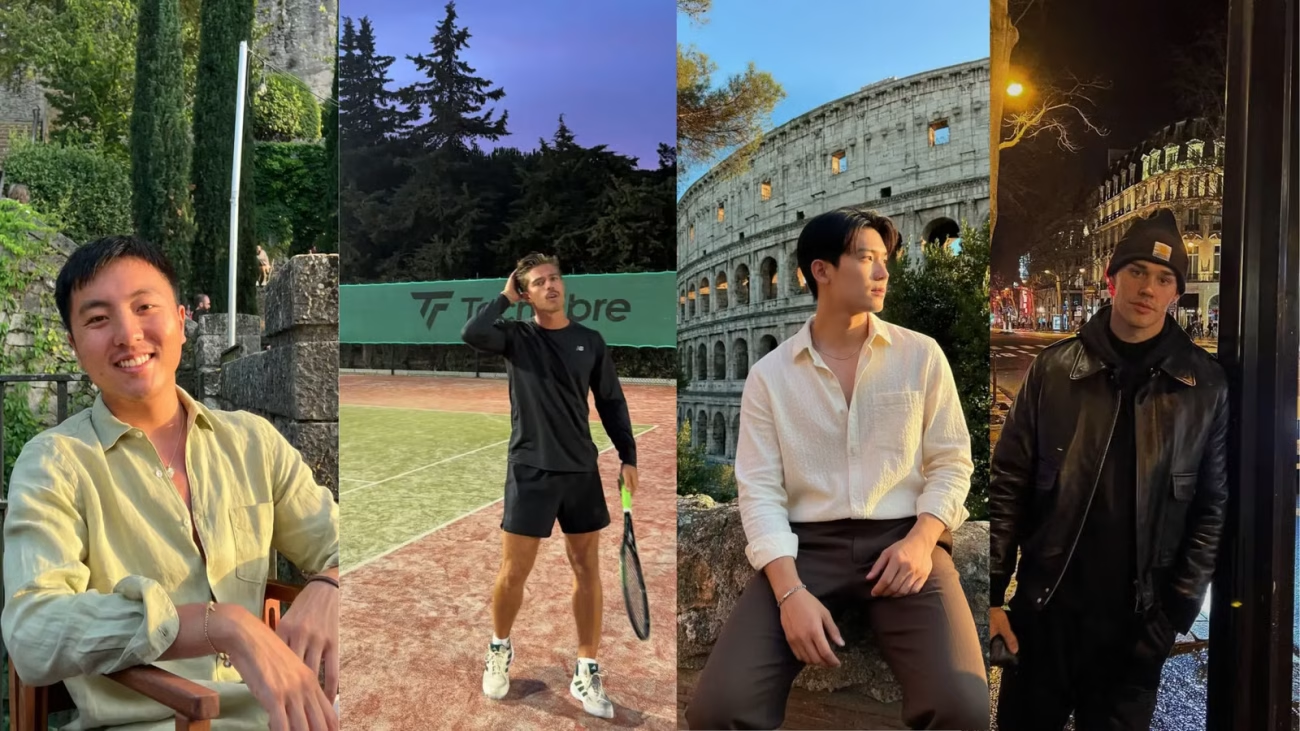
Over the last eighteen months, we have swiped through, screenshotted, and analyzed thousands of dating profiles across Tinder, Hinge, Bumble, and Feeld. We started as skeptics – assuming the “AI dating profile problem” was mostly clickbait and ended up as reluctant believers. Somewhere between the third flawless jawline in a row and the twelfth golden-hour beach shot with a suspiciously smooth left hand, we realized we were looking at an entirely new category of digital deception.
This is what we’ve learned about spotting AI-generated dating photos in 2026 — the specific artifacts, the psychological patterns, the numbers behind the panic, and the tools that actually work. We’ve written it as a practical field guide, not a lecture, because the stakes have quietly become serious. According to the FBI’s 2025 Internet Crime Report, AI-enabled fraud pulled in $893.3 million in adjusted losses last year alone — and romance-adjacent scams sit near the top of the food chain.
The Scale of the Problem: What the 2026 Data Actually Shows
Before we get into detection, we want you to see the landscape the way we see it. The numbers are worse than the headlines suggest, and better than the doomers claim — but only if you know what to look for.
According to McAfee’s 2026 Valentine’s Day research, 35% of online daters have already encountered a fake profile or AI-generated image, and 1 in 7 American adults (roughly 15%) say they have personally lost money to a romance or dating scam. Over in the UK, Barclays’ 2026 Scams Bulletin found that 67% of reported romance scams originate on dating sites and social media, with an average loss of £7,000 per victim in 2025.
Here is a snapshot of what we consider the most decision-relevant 2026 statistics:
| Metric | Value | Source |
|---|---|---|
| Americans who’ve encountered fake/AI profiles while dating | 35% | McAfee 2026 |
| Americans who’ve lost money to a romance scam | 15% (1 in 7) | McAfee 2026 |
| UK romance scams originating on dating/social platforms | 67% | Barclays 2026 |
| Average romance scam loss (UK, 2025) | £7,000 | Barclays 2026 |
| Total FBI-audited AI-fraud losses (2025) | $893.3M | FBI IC3 / Digital Applied |
| Human accuracy at detecting deepfaked images | 53.2% | Digital Applied 2026 |
| People confident they can spot deepfakes | 60% | Digital Applied 2026 |
| Actual perfect-detection rate in controlled tests | 0.1% | Digital Applied 2026 |
| Deepfaked selfie attempts, YoY growth | +58% | Entrust 2026 Identity Fraud Report |
| Share of biometric fraud attempts involving deepfakes | 20% (1 in 5) | Entrust 2026 |
| Gen Z UK singles now prioritizing in-person meetings | 56% | Barclays 2026 |
The number we cannot stop thinking about is that 53.2% detection accuracy for image-based deepfakes. That is one percentage point above a coin flip. In our own informal testing with friends, family, and a few very confident colleagues, we saw the same pattern: people believe they can spot AI photos, and they cannot.
That gap between confidence and competence is exactly where scammers live.
Why Dating Apps Are the Perfect Habitat for AI-Generated Faces

We spent time understanding why dating platforms became such fertile ground for synthetic imagery, because the answer changes how you defend yourself.
Three structural factors combine into what we call the “perfect swipe storm”:
- Low-context viewing: A user looks at a photo for under two seconds before deciding, according to behavioral data from dating UX research. That is not enough time to notice a warped earlobe.
- A visual arms race: Because the platforms reward attractiveness and novelty, users have always used flattering filters. AI-generated photos are the logical endpoint of a decade-long trend, which means they don’t feel jarring in context — they feel like slightly better filters.
- Verification theater: Selfie verification exists on Tinder, Bumble, and Hinge, but as security researchers demonstrated, face authentication has been bypassed using models like StarGANv2. A scammer can pass verification with one real selfie, then populate the gallery with entirely synthetic faces of a completely different person.
We think of the modern fake profile as a hybrid: one real verification selfie glued to a gallery of AI-generated companion shots. This is why the “verified badge” gives us less comfort than it used to.
The Anatomy of an AI-Generated Face: What We Look For First
After looking at thousands of these, we developed a mental checklist. We run through it in about ten seconds per profile. You can too.
1. The Ears and the Jewelry Problem
This is our single most reliable tell. Diffusion models still struggle with ears — they render one ear beautifully and the other slightly melted, mismatched, or missing structure. Earrings are even worse: they appear on one side only, dangle at impossible angles, or fuse into the earlobe. When we see a profile with multiple photos, we specifically compare the same ear across different photos. Real humans have consistent ears. AI subjects rarely do.
2. The Background Is a Confession
Faces are what AI models are best at. Backgrounds are where they get lazy. In analysis published by Northwestern’s Kellogg Insight, researchers identified background artifacts as one of five reliable AI tells. We look for:
- Blurred lettering on signs that “almost” spells a word
- Bookshelves where the spines are shapes rather than titles
- Crowds where every face further from the camera dissolves into mush
- Architectural elements that don’t obey perspective (a doorway leaning subtly the wrong way)
If the person is sharp but the world behind them is a soft impressionist painting, we get suspicious.
3. Hands, Fingers, and the Small-Object Problem
Fingers are the old classic and still work. As SUS IT researchers noted in their 2026 detection guide, we should look closely at finger joints, nail placement, and the way hands interact with objects. Coffee cups fuse to palms. A dog leash disappears halfway to the dog. A wine glass has no stem below the hand gripping it.
4. Skin That Is Too “Correct”
We can now describe the AI look in one phrase: “symmetrical fatigue.” The pores are even. The under-eye shadow is symmetrical. The complexion has one uniform temperature — no ruddiness at the nose tip, no slight discoloration around the chin. Real skin has weather in it. AI skin has the weather turned off.
5. The Consistency Test Across a Gallery
This is the single most powerful test we run, and it takes 15 seconds. We open every photo in the profile and check:
- Do the moles, freckles, and scars move or vanish between photos?
- Are the teeth the same shape and count?
- Is the hairline consistent — same widow’s peak, same cowlick?
- Do earrings, tattoos, and piercings persist across shots?
Real people are stubbornly consistent. AI galleries are subtly not.
A Detection Checklist You Can Actually Use in 10 Seconds
For anyone who wants a portable summary, this is the mental scan we run on a new profile:
| Signal | What “real” looks like | What AI often does |
|---|---|---|
| Ears | Match across photos | One melted, one missing detail |
| Teeth | Same count and shape | Uneven, extra, or shifting |
| Eyes | Slight asymmetry, realistic wetness | Glossy, hollow, or too identical |
| Hairline | Same cowlick every photo | Shifts subtly between shots |
| Hands | 5 fingers with correct joints | Fused, extra, misshapen |
| Background text | Readable | “Almost words” |
| Skin | Uneven color and texture | Uniform, poreless, filtered |
| Jewelry / tattoos | Persistent across gallery | Appear, disappear, or drift |
| Lighting | One consistent source | Face lit differently than shoulders |
| Reflection in eyes/sunglasses | Matches environment | Nonsensical or blurred |
If we flag two or more of these in the same gallery, we assume AI involvement until proven otherwise.
Beyond the Photos: Behavioral Tells That Reinforce the Visual Ones
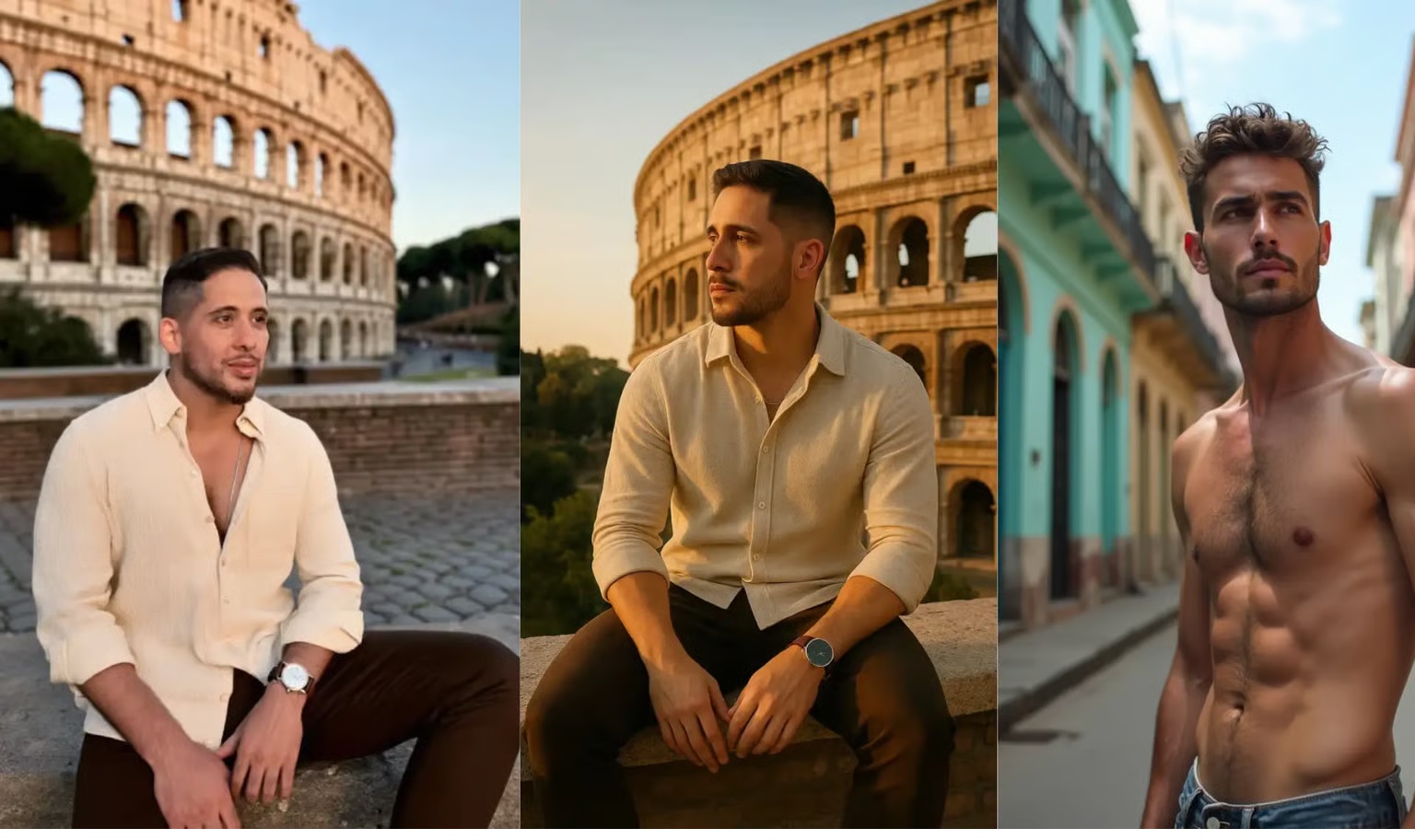
We would be irresponsible if we stopped at pixels. In our observation, the conversation betrays the profile faster than the images do. The 2026 McAfee data lines up almost exactly with what we’ve seen firsthand:
- 52% of scam victims said the responses “felt scripted or repetitive”
- 41% said replies came “instantly and flawlessly”
- 38% noticed photos looked “unnatural or AI-generated”
- 32% were told the person could not do voice or video calls
- 26% received “unusual requests early”
Our own heuristic: if someone’s chat feels like it was drafted by a very polite intern, and every photo looks like it was shot for a stock catalog, we ask for a live video call. This is the single question that a scammer running a synthetic profile cannot easily answer, even in 2026, because real-time deepfake video still degrades under motion, side profiles, and low light. As Barclays’ Kirsty Adams warned, even a quick video call is not proof of identity — but a casual, unscripted video call with a natural turn of the head and hand-in-front-of-face gesture is a much higher bar than most fakes can currently clear.
The Tools We Actually Use (And the Ones We’ve Stopped Trusting)
We tested a spectrum of detection tools over several months. Here is our honest verdict.
Reverse image search
Still our first move. Google Images, TinEye, and Yandex (which is unusually strong for facial matches) can catch stolen or repurposed photos that have been slightly edited by AI to evade a hash match. Yandex in particular has been our workhorse for spotting portraits lifted from Instagram influencers and Eastern European modeling agencies — a genre we saw disproportionately in scam profiles.
Face-specific reverse search
For faces specifically, tools like PimEyes and specialized services like Social Catfish can find the same face across the web even when the exact image doesn’t match. We use these sparingly and ethically — only when we already have a reasonable suspicion.
AI image detectors
We tested several. Our short verdict: they help, but they are not oracles. Detectors from Hive and similar services can flag obvious StyleGAN outputs, but they struggle with the latest diffusion models and with heavily compressed dating-app JPEGs. A “human” verdict from a detector is not proof of humanity; it is one signal among many.
C2PA Content Credentials
This is where the future is. Content Credentials — the C2PA standard — attaches cryptographically signed provenance metadata to images, so viewers can see whether an image came from a real camera or from a generative model. As of 2026, adoption is expanding into professional photography tools, and Meta, Adobe, and OpenAI already tag AI outputs. The catch: metadata gets stripped when platforms re-encode images, and dating apps do not yet display these credentials to end users. We consider this the single most important structural fix on the horizon.
The Benefits People Cite (And Why They Don’t Excuse Deception)
We want to steelman the other side. Not everyone using AI-generated photos on dating apps is a scammer. In our conversations, we heard three recurring justifications:
- “I look better in AI photos than real ones.” This is the aesthetic-improvement argument, and it’s the most common. Services like Aragon.ai and TruShot explicitly market to this need.
- “I’m shy about being photographed.” People with camera anxiety, or who lack recent photos, see AI as a workaround.
- “Everyone else is doing it, so I’m at a disadvantage.” The arms-race argument.
Our editorial view: enhancement (lighting, minor retouching) is one thing; synthesis — generating an image that shows an event, outfit, or setting that never existed — is a different category of communication. The problem is not vanity, it’s misrepresentation. When you show up on a first date and the person has fewer teeth, different hair, and a different jawline than the gallery, the deception happened long before the coffee arrived.
The Real Dangers, Ranked by Severity
We divide the harms into three tiers.
Tier 1: Financial fraud
This is the tier that ends careers and empties retirement accounts. The FBI-audited 2025 data shows adults 60 and over bore $352 million of AI-fraud losses — 39% of the total. Romance scammers use AI photos to construct months-long “relationships,” then pivot to investment schemes, medical emergencies, or crypto lures. The average romance-scam victim, per Barclays, talks to the scammer for seven months before a money request appears.
Tier 2: Non-consensual intimate imagery and sextortion
Because generative models can produce hyper-realistic faces, the same technology enables face-swap sextortion. A victim’s public photos are combined with explicit content and used for blackmail. Legislation is catching up: the U.S. TAKE IT DOWN Act now requires platforms to remove non-consensual deepfake imagery within 48 hours of a report, and 47 of 50 U.S. states had deepfake-specific legislation as of April 2026, per audited compliance data.
Tier 3: Erosion of trust in dating itself
This is the quiet damage. When Barclays surveyed UK singles in early 2026, 48% of Gen Z said AI-scam concerns had changed how they date online — nearly double the 25% national average — and 56% are now prioritizing in-person meetings as a result. We think this is, on balance, healthy. But it also means the entire premise of dating apps is being renegotiated in real time.
What We Think Will Happen Next: The Future of Trust on Dating Apps
We do not think dating apps will disappear. We think they will bifurcate into two categories.
- High-trust apps with cryptographic photo provenance (C2PA credentials embedded at the point of capture), continuous liveness verification, and financial-grade identity checks. Expect subscription pricing and slower growth.
- Volume apps that lean into AI-generated content as a feature rather than a bug, marketing “your best self” imagery openly and shifting the burden of skepticism to the user.
Tinder’s move to mandatory Face Check video selfies in late 2025 is the first sign of the high-trust path. Bumble’s Deception Detector, which auto-actions 95% of accounts flagged as spam or scams, is the second. We expect Hinge to follow within eighteen months.
On the detection side, we expect the human accuracy rate to keep drifting toward pure chance — the current 53.2% will likely dip below 50% within two years, because models are improving faster than human visual training. This is the argument for provenance over detection: instead of asking “can I tell this is AI?”, we should be asking “can this image prove it came from a real camera?”
Our Working Rules for Safer Dating in 2026
We finish with the short list we live by. If you take nothing else from this piece, take this:
- Trust galleries, not portraits. Any single photo can be faked cheaply. Five photos with consistent ears, teeth, moles, and jewelry are harder — but still not impossible — to fake.
- Ask for one specific, unstaged photo. “Can you send me a photo holding today’s newspaper / a mug with your left hand up / making a peace sign?” A real person can produce this in 30 seconds. A synthetic profile cannot.
- Insist on a live video call before any emotional or financial commitment. Not a recorded clip. A live call, with movement, side profile, and a hand across the face.
- Reverse-image-search the top photo. It takes 15 seconds and catches roughly a third of stolen-photo scams in our experience.
- Never send money. Ever. This is the Barclays “SAFE” rule and every fraud unit’s rule, and we agree.
- If a profile feels too polished, treat that as a signal, not a compliment. Symmetrical fatigue is a red flag, not a green one.
We wrote this because we ourselves have been fooled — briefly, embarrassingly, and instructively. The point is not to make anyone paranoid. The point is to give you the same ten-second scan we now run without thinking. Dating online is still worth doing. It just requires slightly more skepticism than it did two years ago, and slightly better tools than the ones the platforms give you by default.
If you take our detection checklist, run it on your last three matches, and one of them makes you frown — trust the frown. In our experience, that instinct is right about as often as the coin flip is wrong: which is to say, considerably more often than we’d like.
You May Also Like
 AI
AIWill AI Replace Game Developers? What Today’s Tools
 Computers & PC Games
How to Allocate More RAM to Minecraft: Complete Guide for Better Performance
 Computers & PC Games
How Much RAM Do You Need for a Minecraft Server?
 Computers & PC Games
What Internet Speed Do I Need For Gaming and Streaming?
 Computers & PC Games
Does a VPN Really Improve Minecraft Ping and Performance?
 VPNs & Proxies